vimsynth/modules/adsr
modules/modulators/ADSR
ADSR
The envelope. Shapes a gate into a contour. Short attack + zero sustain = a pluck; LONG attack + high sustain = a pad. Also emits run (high while the note lives) and eoc (a trigger when it finishes), which is how one envelope drives another.
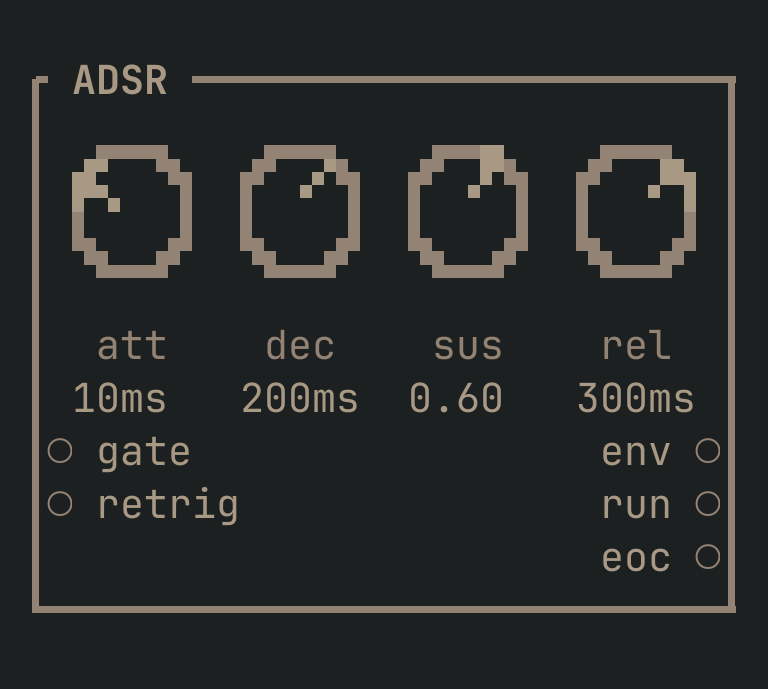
ADSR to get this card.inputs
Down the left edge of the card, top to bottom.
- gategate
- The note. It attacks on the rising edge, HOLDS AT SUSTAIN while this stays high, and releases when it falls. This is a gate and not a trigger: its duration is the length of the note.
- retrigtrigger
- Restarts the attack without needing the gate to fall first.
outputs
Down the right edge, in the same order.
- envcv
- The envelope. Into a VCA's
cvit shapes loudness; into a VCF'scutoffit shapes brightness. Doing both is the classic voice. - rungate
- High for as long as the envelope is doing anything.
- eoctrigger
- A trigger the moment the release finishes. Chain envelopes with it.
knobs
Left to right across the face — the dials in the picture.
- att0.001 … 5 s= 0.01 s
- Attack: how long to reach full. FAST (a few ms) is a pluck or a hit; SLOW (a second or more) is a pad swelling in.
- dec0.001 … 5 s= 0.2 s
- Decay: how long to fall from full to the sustain level.
- sus0 … 1= 0.6
- Sustain: the level it HOLDS at while the gate stays high. ZERO makes a pluck (the note dies whatever you do); HIGH makes a pad (the note lasts as long as the key is down).
- rel0.001 … 5 s= 0.3 s
- Release: how long to fade after the gate falls. Long release is what makes a sound linger and overlap.
more
The full reference — every parameter curve, the patching notes and the worked examples — lives in the manual: docs.vimsynth.com/modules/adsr. In the app itself, :help ADSR opens the same page without leaving the rack.