vimsynth/modules/crush
modules/processors/CRUSH
CRUSH
A bitcrusher: throws away amplitude resolution (bits) and time resolution (rate, a sample-and-hold at less than full speed) independently of each other. Not the same corner DRIVE's crush shape touches — that one is a single gain-coupled quantiser fused into a saturation curve. This is the standalone, two-axis, unmistakably-digital kind of ugly: aliased and stair-stepped rather than warm or clipped.
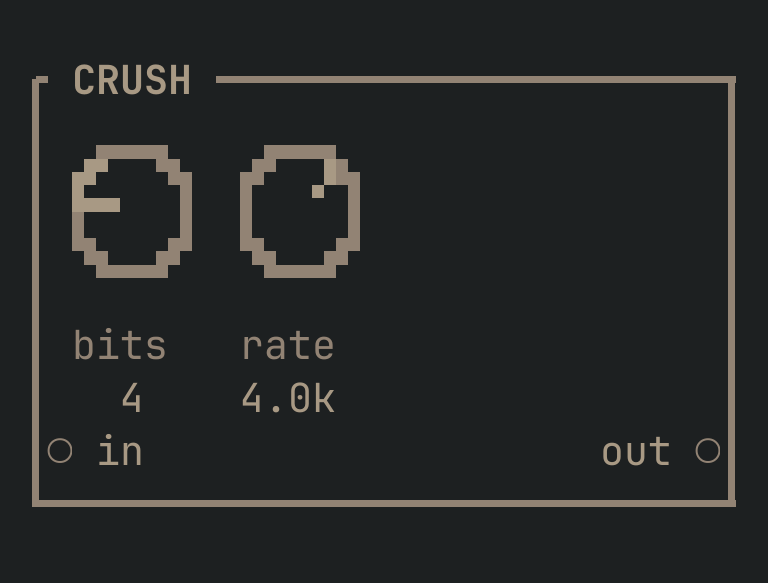
CRUSH to get this card.inputs
Down the left edge of the card, top to bottom.
- inaudio
- The signal to crush.
outputs
Down the right edge, in the same order.
- outaudio
- The signal, stair-stepped in level and held in time.
knobs
Left to right across the face — the dials in the picture.
- bits1 … 16= 4
- Amplitude resolution. Low is a handful of steps; high is close to untouched.
- rate200 … 20000 hz= 4000 hz
- How often it actually samples the input. Low holds each value for a long time, which is the classic lo-fi stutter.
more
The full reference — every parameter curve, the patching notes and the worked examples — lives in the manual: docs.vimsynth.com/modules/crush. In the app itself, :help CRUSH opens the same page without leaving the rack.