vimsynth/modules/track
modules/modulators/TRACK
TRACK
PITCH TO VOLTAGE — the other half of FOLLOW. That one answers 'how loud is this'; this one answers 'what NOTE is this', and until it existed nothing in the rack could tell. Audio in; v/oct out, a gate while it is sure, and a trig each time the note changes. Patch a guitar, a voice, a field recording or a sample into it and the rack plays what you played: into a VCO to double it, into WARP's v/oct so the room follows your line, into a SEQ to capture it. snap lands the output on the degrees of the rack's own scale, so a bent string or a sung note plays whatever :tune is set to — including the microtonal ones. It hears one voice at a time: a chord or a drum has no single period and the gate stays shut rather than inventing one.
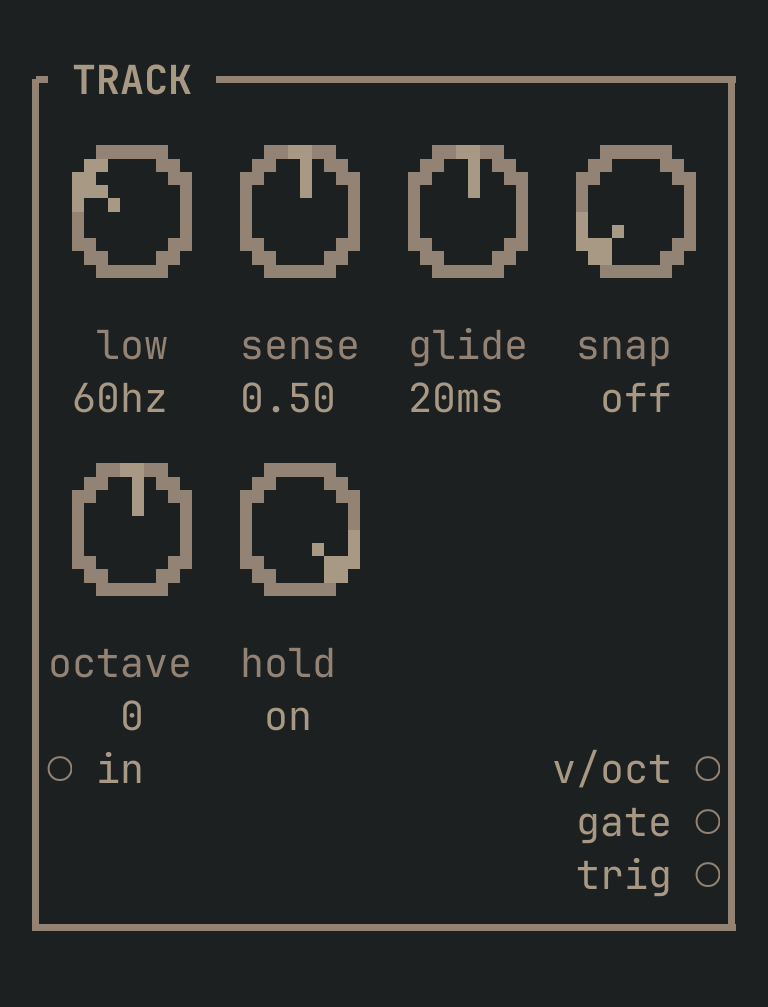
TRACK to get this card.inputs
Down the left edge of the card, top to bottom.
- inaudio
- The sound to listen to. ONE voice at a time — it finds a period, and a chord does not have one. Clean and sustained tracks best; a fuzz pedal's worth of harmonics is fine, a cymbal is not.
outputs
Down the right edge, in the same order.
- v/octpitch
- The note it is hearing, as pitch CV — 1.0 per octave, 0.0 is middle C, the same scale every oscillator here tunes from. Straight into a VCO's
v/octand the rack doubles you. - gategate
- High while it is SURE, which is what
sensesets. Into an ADSR this makes the rack's envelope follow your playing; it also tells you honestly when there is no note to be had. - trigtrigger
- One pulse each time the NOTE CHANGES, even without a gap in the playing — so a legato line still re-strikes an envelope or fires a PLUCK.
knobs
Left to right across the face — the dials in the picture.
- low30 … 400 hz= 60 hz
- The lowest pitch it will hunt for. This is the one dial that costs something: a period cannot be measured before it has happened, so a low setting tracks a bass but answers later. 60 Hz suits a guitar; raise it for a voice or a lead and the tracking gets quicker.
- sense0 … 1= 0.5
- How sure it has to be before
gateopens. Low is trusting — it will name a note in a noisy signal; high only speaks up on a clean sustained one. - glide0.001 … 0.5 s= 0.02 s
- Smoothing on the pitch output. Some is essential (a tracker with none jitters a few cents and every oscillator downstream wobbles); too much and a played line arrives late. Around 20 ms is a good line.
- snapoff · scale= off
- Snap the output to the degrees of the RACK's scale, so a bent string, a slide or a sung note plays the key the patch is in — 19-TET, Hijaz, whatever
:tunesays. - octave-3 … 3= 0
- Octaves added to the output. Play a bass line off a guitar, or a lead two octaves up.
- holdoff · on= on
- Hold the last note when the sound stops, instead of letting the pitch drift wherever silence takes it.
gatestill closes either way; this only decides whatv/octsays in between.
more
The full reference — every parameter curve, the patching notes and the worked examples — lives in the manual: docs.vimsynth.com/modules/track. In the app itself, :help TRACK opens the same page without leaving the rack.