vimsynth/modules/delay
modules/processors/DELAY
DELAY
An echo. sync locks the delay time to a clock so the repeats land on the beat. Its internal feedback is not a graph cycle, so this is how you get feedback at all — the engine rejects patched loops.
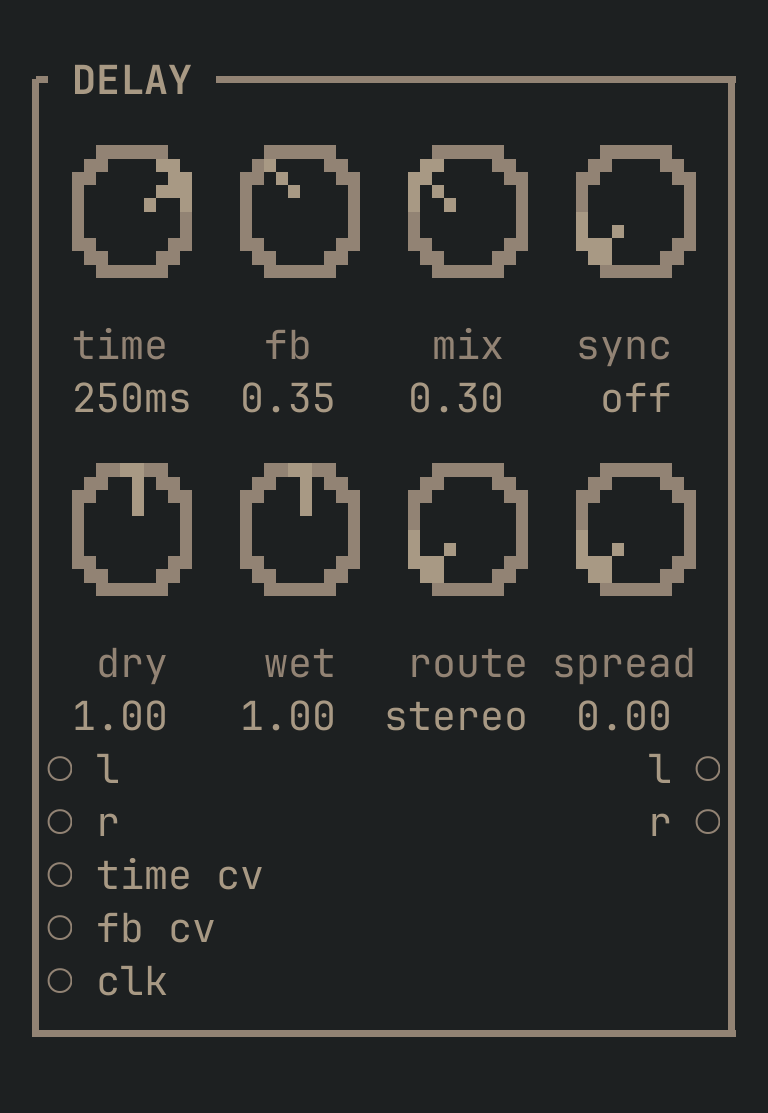
DELAY to get this card.inputs
Down the left edge of the card, top to bottom.
- laudio
- The signal to delay, left.
- raudio
- The right side. Normals from
l, so ONE cable in is the mono delay this always was — patch both and it stays stereo all the way through. - time cvcv
- Modulates the delay time. Not smoothed, so an LFO here works at full rate — that is chorus/flanger territory.
- fb cvcv
- Modulates the feedback.
- clktrigger
- A clock to lock to, when
syncis on. The echoes then land on the beat.
outputs
Down the right edge, in the same order.
- laudio
- Dry and echoes, mixed by
mix. Left. - raudio
- The right side. On
route=stereothe two lines are independent, so a stereo source stays where it was put; onpingthe feedback crosses and a hit walks left-right-left across the field, one delay time per step.spreadpushes the right side's time away from the left's for a wider, less centred echo.
knobs
Left to right across the face — the dials in the picture.
- time0.001 … 2 s= 0.25 s
- The delay time, when
syncis off. - fb0 … 0.95= 0.35
- How much comes back. High values repeat for a long time.
- mix0 … 1= 0.3
- Dry/wet CROSSFADE: as the echoes come up the dry signal goes down. For echoes ADDED on top of an undiminished dry signal — a send — leave this at 0.5 and use
dry/wet. - syncoff · x1 · x2 · x3 · x4 · x6 · x8 · x16= off
- Lock the time to
clk, in multiples of a pulse. Off, andtimerules. - dry0 … 2= 1
- A trim on the DRY side of
mix, 0–2. 1.0 leaves the crossfade as it is; withmixat 0.5, turning this to 2.0 puts the dry signal back to full. - wet0 … 2= 1
- A trim on the WET side of
mix, 0–2 — the echoes' own level.mix0.5 with both trims at 2.0 is a SEND: the dry signal whole, the echoes over the top. - routestereo · ping= stereo
- How the two sides are wired to each other.
stereokeeps each side to itself — a mono source in is the mono delay this has always been.pingcrosses the feedback, so a single hit walks left-right-left across the field, one delay time per step. - spread0 … 1= 0
- How far apart the two sides' delay times are. 0 is dead centre and identical; up, the right side runs progressively later than the left, which reads as WIDTH rather than as two delays. Leave it at 0 for a ping-pong — crossed feedback wants equal times or it stops sounding like a bounce.
more
The full reference — every parameter curve, the patching notes and the worked examples — lives in the manual: docs.vimsynth.com/modules/delay. In the app itself, :help DELAY opens the same page without leaving the rack.