vimsynth/modules/reson
modules/processors/RESON
RESON
A resonant BODY — modal synthesis. It does not make a sound, it ANSWERS one: hit it with a click, a drum or a whole voice and it rings in that shape. struct sweeps its modes from harmonic (a string, has a pitch) to inharmonic (a bell or a bar, sounds like an object being struck).
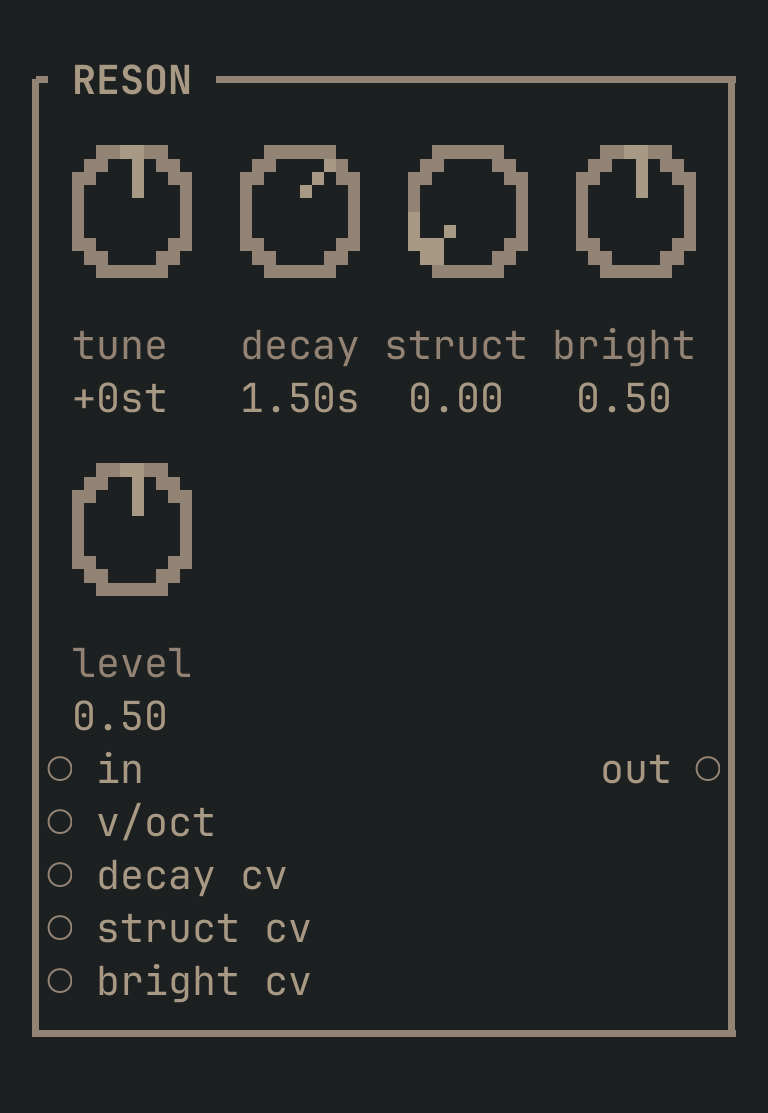
RESON to get this card.inputs
Down the left edge of the card, top to bottom.
- inaudio
- THE EXCITER — what strikes the body, and RESON's ONLY trigger. There is NO
trig/gateinput: to fire it from a drum trigger, a clock, or a META/SEQ gate, wire that straight intoin. A short click or gate makes it ring like a struck object; a sustained sound makes it a resonant filter bank. - v/octpitch
- The fundamental. 1.0 = an octave up.
- decay cvcv
- Modulates how long it rings.
- struct cvcv
- Modulates
struct— sweeps the body from string toward bell. Added to the knob. An LFO or envelope here is how you get TIMBRAL variance without changing pitch: the object morphs as it rings, or from strike to strike. - bright cvcv
- Modulates
bright— the material, from dull wood to bright glass/metal. Added to the knob. Pair withstruct cvto make a resonant part that evolves instead of striking the same timbre every time.
outputs
Down the right edge, in the same order.
- outaudio
- The body, ringing.
knobs
Left to right across the face — the dials in the picture.
- tune-36 … 36 st= 0 st
- The fundamental, in semitones.
- decay0.02 … 20 s= 1.5 s
- How long it rings.
- struct0 … 1= 0
- STRING (0) to BELL (1). At 0 the modes are whole multiples and the ear hears a pitch; at 1 they are not, and it hears an OBJECT being struck.
- bright0 … 1= 0.5
- How much of the upper modes survives. Dull is wood; bright is glass or metal.
- level0 … 1= 0.5
- Output level.
more
The full reference — every parameter curve, the patching notes and the worked examples — lives in the manual: docs.vimsynth.com/modules/reson. In the app itself, :help RESON opens the same page without leaving the rack.