vimsynth/modules/grain
GRAIN
Granular synthesis: takes a recording apart into short windowed grains and scatters them into a cloud. Freeze pos and half a second becomes an endless texture that still sounds like what it came from. Stereo out. Every knob has a CV — slot, size and spray included — so an envelope or a sequencer can be turning several of them against each other at once.
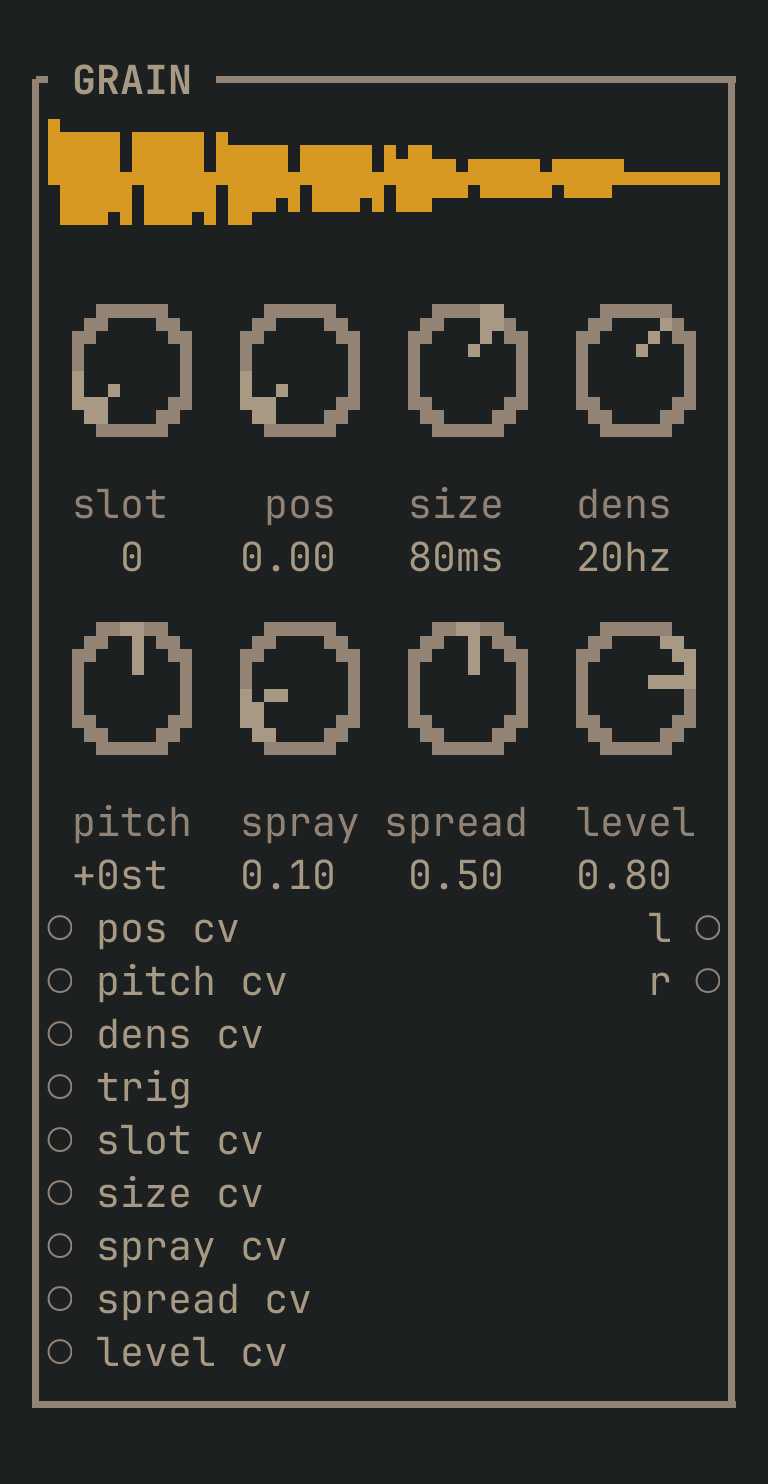
GRAIN to get this card.inputs
Down the left edge of the card, top to bottom.
- pos cvcv
- Moves the point in the sample the grains are taken from. Sweep it slowly to scan through a sound; freeze it to hold one moment for ever.
- pitch cvcv
- Transposes the grains, in octaves.
- dens cvcv
- Modulates how many grains a second.
- trigtrigger
- Fires a single grain, over and above the density. A clock here places grains on the beat instead of scattering them. It does NOT switch the voice on and off — one trigger is one grain, so to gate or envelope a grain sound use
level cv, not this. - slot cvcv
- Switches which bank slot the grains are cut from. Additive on the slot number itself — an LFO here scans across whatever sounds are loaded.
- size cvcv
- Scales the grain length — a ratio on the
sizeknob, not an offset, so the same modulation depth wobbles proportionally whatever the base length is. - spray cvcv
- Modulates how far a grain may wander from
pos. Turn it up with an envelope and a stutter opens into a cloud partway through a note. - spread cvcv
- Modulates how wide the cloud sits in the stereo field.
- level cvcv
- Modulates the output level, and normals to full when unpatched. This is how you GATE or envelope a GRAIN voice: patch an ADSR or a gate here to make it a hi-hat, a pluck, a swell — GRAIN has no VCA of its own, so this port is its amplitude. Do not reach for
trigto switch a grain sound on and off; that only sprays a grain.
outputs
Down the right edge, in the same order.
- laudio
- The cloud, left. A cloud is born stereo — take both.
- raudio
- The cloud, right.
knobs
Left to right across the face — the dials in the picture.
- slot0 … 63= 0
- Which bank slot.
- pos0 … 1= 0
- Where in the sound the grains come from. FREEZE this and half a second becomes an endless texture.
- size0.005 … 0.5 s= 0.08 s
- How long each grain is. Short is a fine hiss; long keeps the character of the source.
- dens0.5 … 200 hz= 20 hz
- How many grains a second. Sparse is a stutter; dense is a cloud.
- pitch-24 … 24 st= 0 st
- Transposes the grains, in semitones.
- spray0 … 1= 0.1
- How far a grain may wander from
pos. This is what turns a stutter into a CLOUD — with no spray, every grain is the same grain. - spread0 … 1= 0.5
- How wide the cloud sits in the stereo field.
- level0 … 1= 0.8
- Output level.
more
The full reference — every parameter curve, the patching notes and the worked examples — lives in the manual: docs.vimsynth.com/modules/grain. In the app itself, :help GRAIN opens the same page without leaving the rack.