vimsynth/modules/lfo
LFO
A slow oscillator, for modulating things. Unipolar by default (0..1), which is what a VCA level or a filter cutoff wants. sync locks it to a clock and starts it ON the pulse.
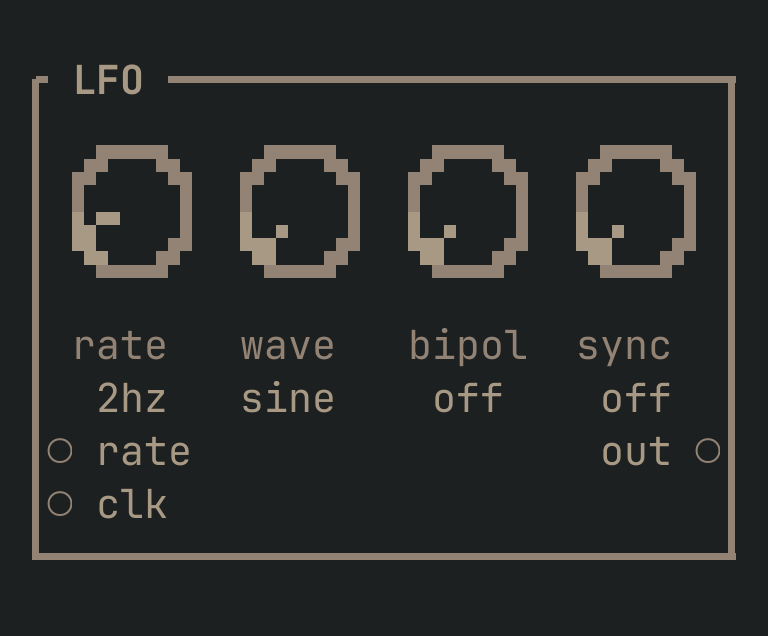
LFO to get this card.inputs
Down the left edge of the card, top to bottom.
- ratecv
- Modulates the rate, in octaves.
- clktrigger
- A clock to lock to, when
syncis on. The cycle then begins ON the pulse, not merely at its speed.
outputs
Down the right edge, in the same order.
- outcv
- The modulation. Unipolar (0..1) unless
bipolis on — which is what a VCA level or a filter cutoff wants.
knobs
Left to right across the face — the dials in the picture.
- rate0.05 … 20 hz= 2 hz
- How fast. Under 1 Hz is drift and swell; a few Hz is vibrato or tremolo.
- wavesine · tri · saw · sqr= sine
- Shape.
sineandtriare smooth;sqrsteps;sawramps. - bipoloff · on= off
- Bipolar (−1..1) instead of unipolar (0..1). Leave it OFF for a VCA level or a filter cutoff; turn it ON for vibrato, where the pitch must go both ways.
- syncoff · x1 · x2 · x3 · x4 · x6 · x8 · x16= off
- Lock the cycle to
clk. Off, andraterules.
more
The full reference — every parameter curve, the patching notes and the worked examples — lives in the manual: docs.vimsynth.com/modules/lfo. In the app itself, :help LFO opens the same page without leaving the rack.