vimsynth/modules/poly
POLY
A unison stack: several detuned copies of ONE voice, born stereo. This rack has no notion of true polyphony — a cable carries one voice, and that is the whole of what makes it modular — so this is what a synth means by 'polyphonic' when it cannot literally play several notes: a supersaw, a string section, a pad that sounds like more than one oscillator because it is. voices sets how many; detune spreads them symmetrically around the pitch you asked for, so more voices thickens the tone without ever bending it sharp or flat; spread fans them across the stereo field so the detuning is placed as well as heard.
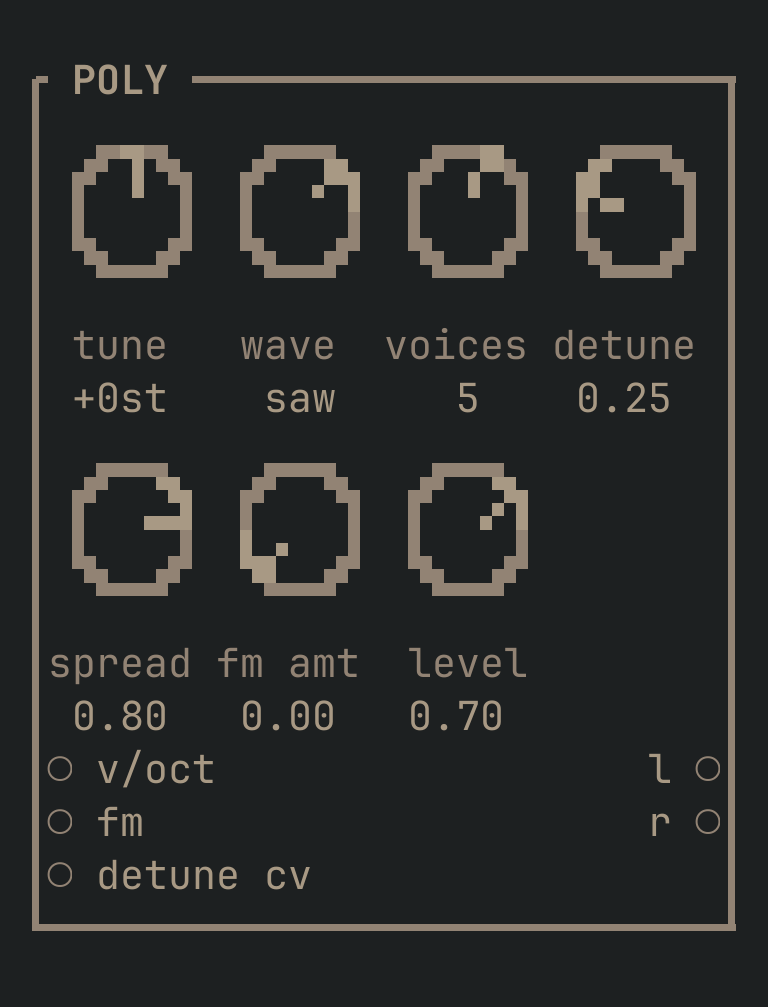
POLY to get this card.inputs
Down the left edge of the card, top to bottom.
- v/octpitch
- Pitch. 1.0 = one octave up. Every voice in the stack tracks it, detuned symmetrically around exactly this note.
- fmcv
- Added to every voice's pitch, scaled by
fm amt. Small values are vibrato across the whole stack at once. - detune cvcv
- Added to the
detuneknob. An envelope here is a stack that widens as the note is struck — the unison version of a filter opening.
outputs
Down the right edge, in the same order.
- laudio
- The stack, left. Born stereo —
spreadfans the voices across the field, so summing this down to mono throws the width away. - raudio
- The stack, right.
knobs
Left to right across the face — the dials in the picture.
- tune-24 … 24 st= 0 st
- Pitch offset in semitones.
- wavesine · tri · saw · sqr= saw
- The waveform every voice in the stack shares.
- voices1 … 8= 5
- How many detuned voices. One is a plain oscillator; the point starts around three.
- detune0 … 1= 0.25
- How far apart the voices sit, symmetrically around the pitch you asked for — the outermost two are at most a semitone apart at full detune. 0 puts every voice on exactly the same note.
- spread0 … 1= 0.8
- How far the fanned-out voices sit across the stereo field. 0 is mono; turned up, the detuning is placed as well as heard.
- fm amt0 … 1= 0
- How far the
fminput moves every voice's pitch together. - level0 … 1= 0.7
- Output level. The stack is normalised so more voices does not mean louder, but detuned voices drift in and out of phase — that drift IS the beating — and where they line up the peak is
sqrt(voices)higher than the average. This is the headroom knob for that: turn it DOWN as you turnvoicesup.
more
The full reference — every parameter curve, the patching notes and the worked examples — lives in the manual: docs.vimsynth.com/modules/poly. In the app itself, :help POLY opens the same page without leaving the rack.