vimsynth/modules/cmpx
CMPX
A complex oscillator: two operators in one card, wired the west-coast way. A carrier and a modulator that TRACKS it by ratio, joined by through-zero LINEAR FM — which, unlike the VCO's exponential fm, stays in tune as it gets brighter, so it is a bell rather than a siren. A built-in wavefolder is the timbre: sweep it with an envelope and the sound opens up. A whole-number ratio is harmonic; anything between clangs. The modulator has its own output, so it is never wasted.
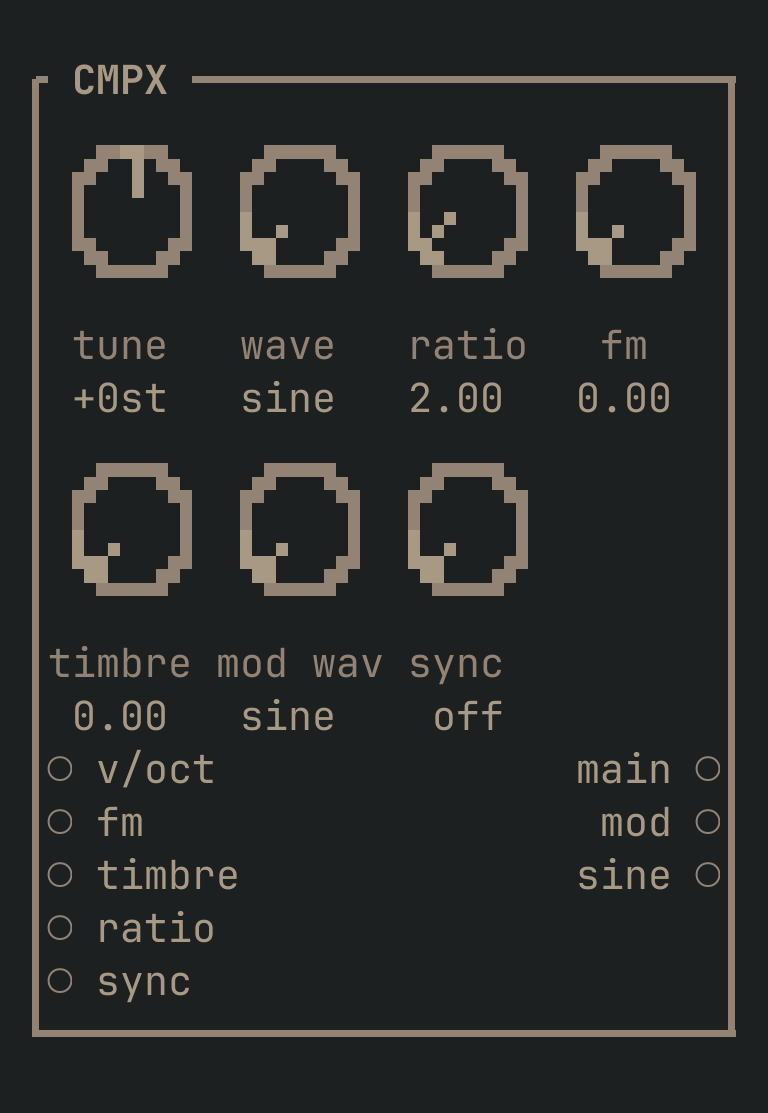
CMPX to get this card.inputs
Down the left edge of the card, top to bottom.
- v/octpitch
- Pitch. 1.0 = one octave up. Both oscillators track it — the modulator stays a fixed
ratioabove the carrier. - fmcv
- Added to the FM
index. This is the axis of the sound: an envelope here is dynamic FM, brightening on the attack. No depth knob — use an ATT. - timbrecv
- Added to the
timbreknob — the wavefolder. An envelope here is the west-coast gesture: the tone opens up as the note is struck. - ratiocv
- Added to the
ratioknob, sweeping the modulator's frequency relative to the carrier. Sweeping through whole numbers is a slide from harmonic to clangorous and back. - synctrigger
- An external hard sync: a rising edge restarts the carrier. The other hard sync is internal — the modulator wrapping, switched on with the
syncknob.
outputs
Down the right edge, in the same order.
- mainaudio
- The carrier, FM'd and folded — the complex voice. This is the one you listen to.
- modaudio
- The modulator on its own. When it is not FMing the carrier it is just a second oscillator, a sub, or a cross-mod source.
- sineaudio
- A clean sine at the carrier's fundamental, before the fold. Mix it back under a screaming
mainto put the body back.
knobs
Left to right across the face — the dials in the picture.
- tune-24 … 24 st= 0 st
- Carrier pitch offset, in semitones.
- wavesine · tri · saw · sqr= sine
- The carrier waveform.
sineby default: it has nothing to fold out, so the fold IS the timbre. A richer wave folds into something more aggressive. - ratio0.25 … 32= 2
- The modulator's frequency, as a multiple of the carrier's. WHOLE numbers are harmonic and musical (2 is an octave up); anything between is inharmonic and clangorous — a bell, a gong, metal.
- fm0 … 10= 0
- Linear FM index. The main axis of the sound. 0 is a plain oscillator; past 1 the FM goes THROUGH ZERO and the carrier runs backwards, which is why the pitch stays put as the tone gets brighter.
- timbre0 … 1= 0
- The wavefolder — timbre. Push it and the carrier gets brighter and more complex. Sweep it with an envelope on the
timbreinput and that is the west-coast voice in one gesture. - mod wavesine · tri · saw · sqr= sine
- The modulator's waveform.
- syncoff · hard= off
- Internal hard sync: the modulator's cycle restarts the carrier's, chopping it mid-flight for a ripping, formant-y tone.
more
The full reference — every parameter curve, the patching notes and the worked examples — lives in the manual: docs.vimsynth.com/modules/cmpx. In the app itself, :help CMPX opens the same page without leaving the rack.