vimsynth/modules/punch
PUNCH
A struck percussion voice — a kick, a snare, a hat, all the same card. Three layers mix together: bend sweeps the body's pitch down with its OWN decay separate from the body's own, which is what makes a hit snap rather than just ring; click is the transient at the very start; noise is a separately-decaying, separately-toned noise layer, off by default so the bare hit is a clean kick.
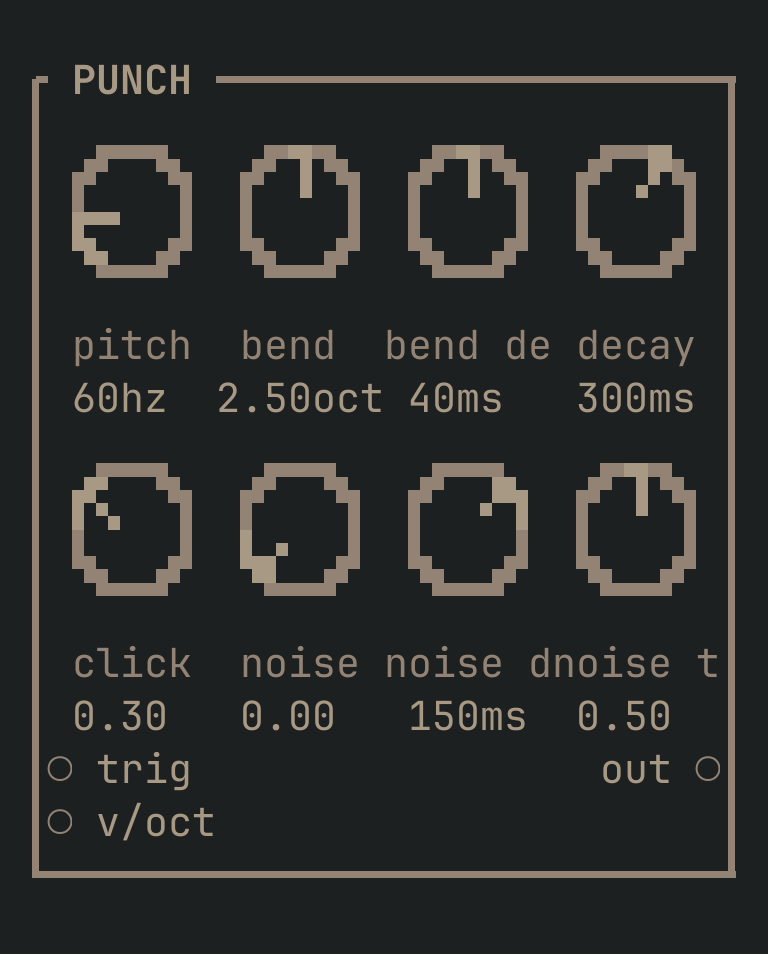
PUNCH to get this card.inputs
Down the left edge of the card, top to bottom.
- trigtrigger
- Fires the hit. Body, click and noise all start together — the rising edge is the whole event.
- v/octpitch
- Tunes the whole voice. 1.0 = one octave up.
outputs
Down the right edge, in the same order.
- outaudio
- The hit — body, click and noise, already mixed.
knobs
Left to right across the face — the dials in the picture.
- pitch30 … 2000 hz= 60 hz
- The body's rest pitch.
- bend0 … 5 oct= 2.5 oct
- How far the pitch envelope sweeps up from
pitchat the strike, in octaves. - bend decay0.001 … 1 s= 0.04 s
- The pitch envelope's OWN decay — separate from
decaybelow. Fast is a snap or a click; slow is a glide into a tom. - decay0.01 … 3 s= 0.3 s
- The body's own amplitude decay.
- click0 … 1= 0.3
- Level of the ~3ms transient at the very start — the sound of the stick making contact.
- noise0 … 1= 0
- Level of the separately-enveloped noise layer. Zero by default, so the bare hit is a clean kick.
- noise decay0.001 … 2 s= 0.15 s
- The noise layer's own decay.
- noise tone0 … 1= 0.5
- The noise layer's own tone: dark and lowpassed at 0, bright and highpassed at 1 — one knob from a snare's body to a hat's hiss.
more
The full reference — every parameter curve, the patching notes and the worked examples — lives in the manual: docs.vimsynth.com/modules/punch. In the app itself, :help PUNCH opens the same page without leaving the rack.