vimsynth/modules/lpg
modules/processors/LPG
LPG
A vactrol-style low-pass gate. One strike trigger drives a single envelope that shapes amplitude and — depending on color — the filter's cutoff together, the way a real vactrol's LED and light-dependent resistor decay on the same curve. Bright at the strike, and either just quieter or also darker as it dies away. decay is the module: short is snappy, long is sluggish.
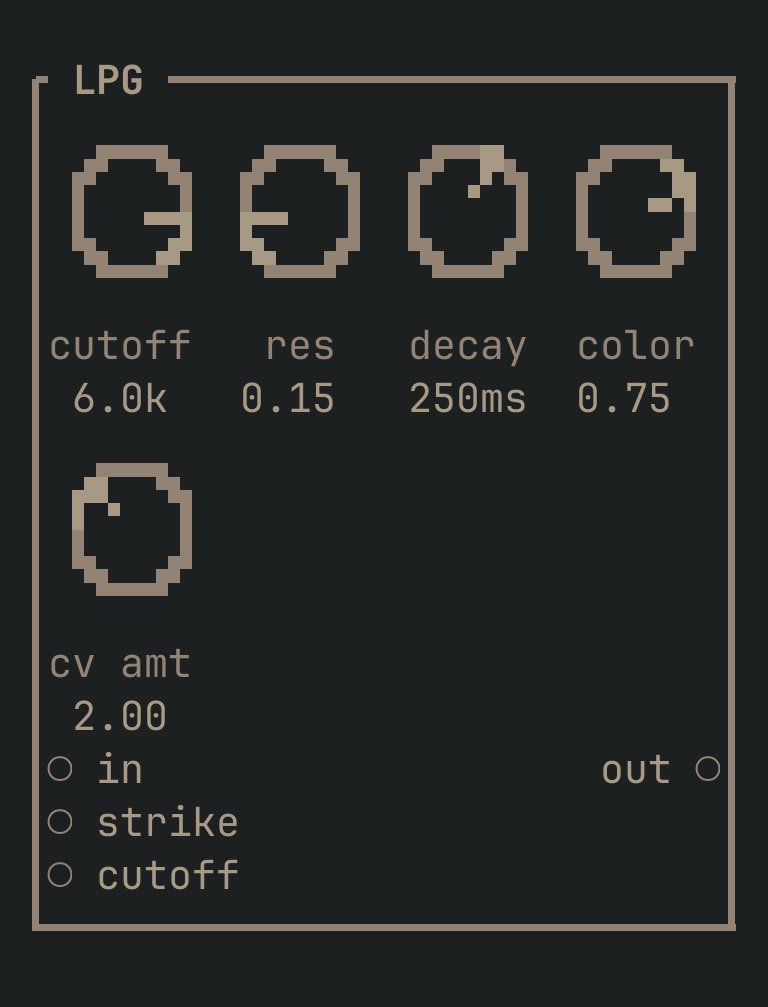
LPG to get this card.inputs
Down the left edge of the card, top to bottom.
- inaudio
- The signal to gate.
- striketrigger
- Fires the vactrol. Amplitude, and — depending on
color— cutoff, both start decaying from here. - cutoffcv
- Moves the cutoff, in OCTAVES, scaled by the
cv amtknob, same convention as VCF's own.
outputs
Down the right edge, in the same order.
- outaudio
- The gated, and — depending on
color— filtered, signal.
knobs
Left to right across the face — the dials in the picture.
- cutoff20 … 18000 hz= 6000 hz
- The ceiling the vactrol opens up to at the instant of a strike.
- res0 … 1= 0.15
- Resonance at that ceiling. An LPG is not a synth-lead filter — keep it low.
- decay0.005 … 3 s= 0.25 s
- The vactrol's own release. This is the module: short is snappy, long is sluggish.
- color0 … 1= 0.75
- Blends VCA-only (0: brightness stays put, only level follows the strike) into full LPG (1: cutoff closes down right along with level, so a quiet tail is also a dark one).
- cv amt0 … 6= 2
- How many octaves the
cutoffinput moves it, same convention as VCF's own.
more
The full reference — every parameter curve, the patching notes and the worked examples — lives in the manual: docs.vimsynth.com/modules/lpg. In the app itself, :help LPG opens the same page without leaving the rack.