vimsynth/modules/vcf
modules/processors/VCF
VCF
Resonant filter, state-variable. Three outputs at once: lowpass (dark, the usual choice), bandpass (hollow, good for rain and voice-like sounds), highpass (thin). The workhorse of subtractive synthesis.
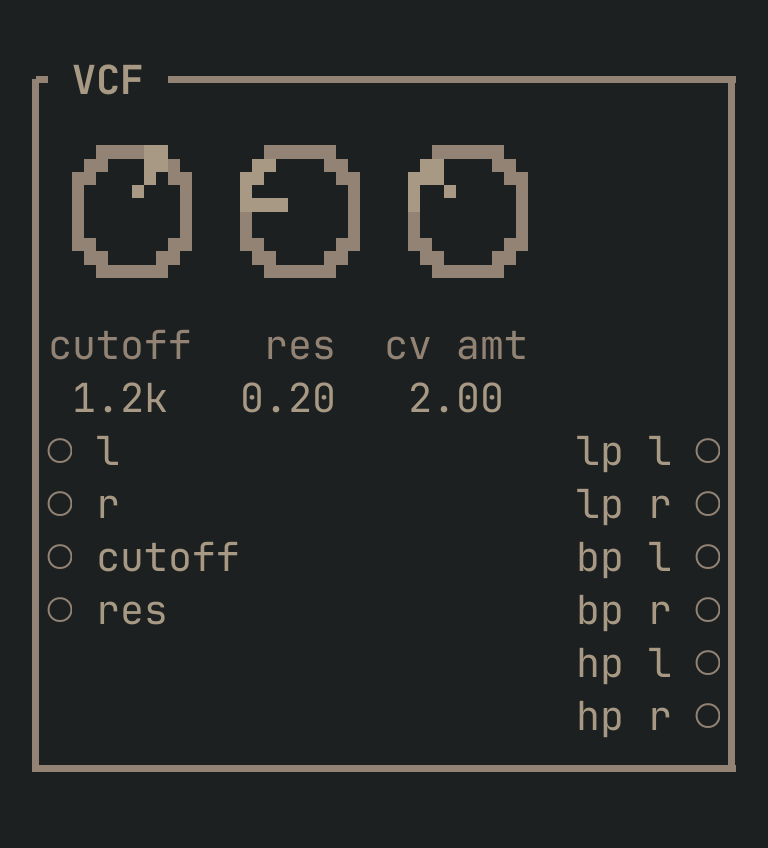
VCF to get this card.inputs
Down the left edge of the card, top to bottom.
- laudio
- The signal to filter, left.
- raudio
- The right side. Normals from
l, so ONE cable in is the mono filter this always was — patch both and it stays stereo all the way through. - cutoffcv
- Moves the cutoff, in OCTAVES, scaled by the
cv amtknob. An ADSR here is the classic filter sweep. - rescv
- Modulates the resonance.
outputs
Down the right edge, in the same order.
- lp laudio
- Lowpass: keeps the lows. THE usual choice — dark, round, the sound of subtractive synthesis.
- lp raudio
- Lowpass: keeps the lows. THE usual choice — dark, round, the sound of subtractive synthesis. The right side.
- bp laudio
- Bandpass: keeps a band. Hollow, nasal, vocal. Noise through a swept bandpass is wind, rain and surf.
- bp raudio
- Bandpass: keeps a band. Hollow, nasal, vocal. Noise through a swept bandpass is wind, rain and surf. The right side.
- hp laudio
- Highpass: keeps the highs. Thin, brittle; also how you take the mud out of a layer.
- hp raudio
- Highpass: keeps the highs. Thin, brittle; also how you take the mud out of a layer. The right side.
knobs
Left to right across the face — the dials in the picture.
- cutoff20 … 18000 hz= 1200 hz
- The cutoff. Low is dark and muffled; high is open and bright. THE most-modulated knob in subtractive synthesis.
- res0 … 1= 0.2
- Resonance. Emphasises the cutoff; high values whistle and, at the top, self-oscillate. Keep it LOW for anything described as soft, warm or soothing.
- cv amt0 … 6= 2
- How many octaves the
cutoffinput moves it. This is the depth control for a filter sweep.
more
The full reference — every parameter curve, the patching notes and the worked examples — lives in the manual: docs.vimsynth.com/modules/vcf. In the app itself, :help VCF opens the same page without leaving the rack.