vimsynth/modules/min
MIN
MIDI notes from a port or a DAW, as CV: a monophonic voice with last-note priority, emitting v/oct, gate and vel. Pick a channel (0 is omni). A MIDI note is a scale DEGREE above root, so a chromatic keyboard plays the rack's own tuning degree by degree — not necessarily 12 to the octave.
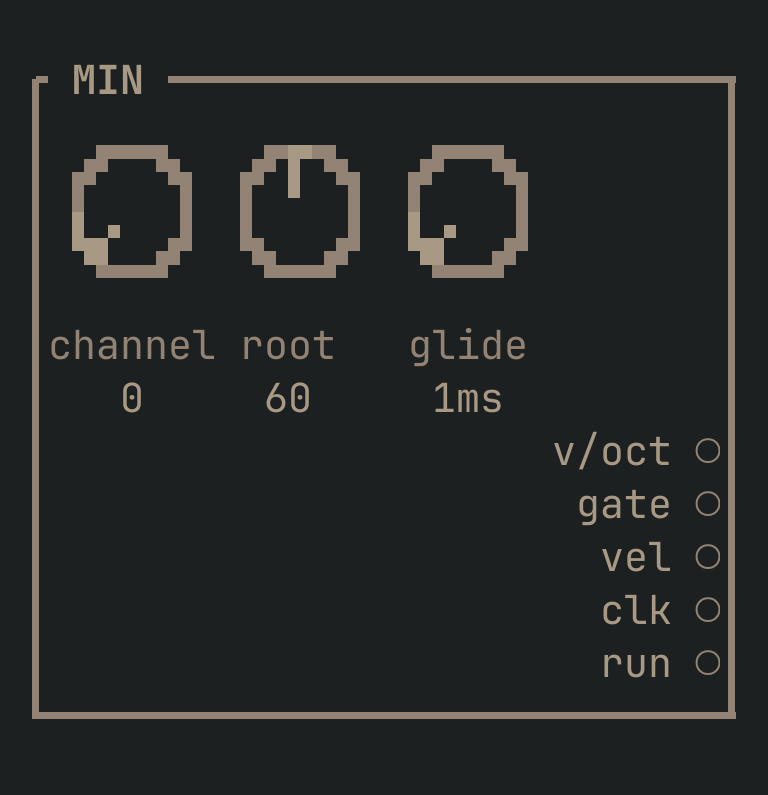
MIN to get this card.outputs
Down the right edge, in the same order.
- v/octpitch
- The held MIDI note, as octaves — a scale degree above
root. - gategate
- High while any note is held on the chosen channel.
- velcv
- Velocity of the most recent note, 0..1.
- clktrigger
- A pulse on every quarter note of the incoming MIDI clock (24 ppqn, divided down). Patch it where a CLOCK's gate would go to run the rack in time with a DAW.
- rungate
- High between MIDI Start/Continue and Stop — the port's transport, as a gate.
knobs
Left to right across the face — the dials in the picture.
- channel0 … 16= 0
- Which MIDI channel to answer, 1–16. 0 is omni — every channel.
- root0 … 127= 60
- The MIDI note that is degree 0 of the scale. 60 is middle C.
- glide0.001 … 1 s= 0.001 s
- Portamento between notes.
more
The full reference — every parameter curve, the patching notes and the worked examples — lives in the manual: docs.vimsynth.com/modules/min. In the app itself, :help MIN opens the same page without leaving the rack.