vimsynth/modules/slew
modules/modulators/SLEW
SLEW
Smooths a signal: a rise time and a fall time, separately. Three things at once — portamento on a pitch, a smoother on a stepped S&H, and a cheap attack/release envelope if you feed it a gate.
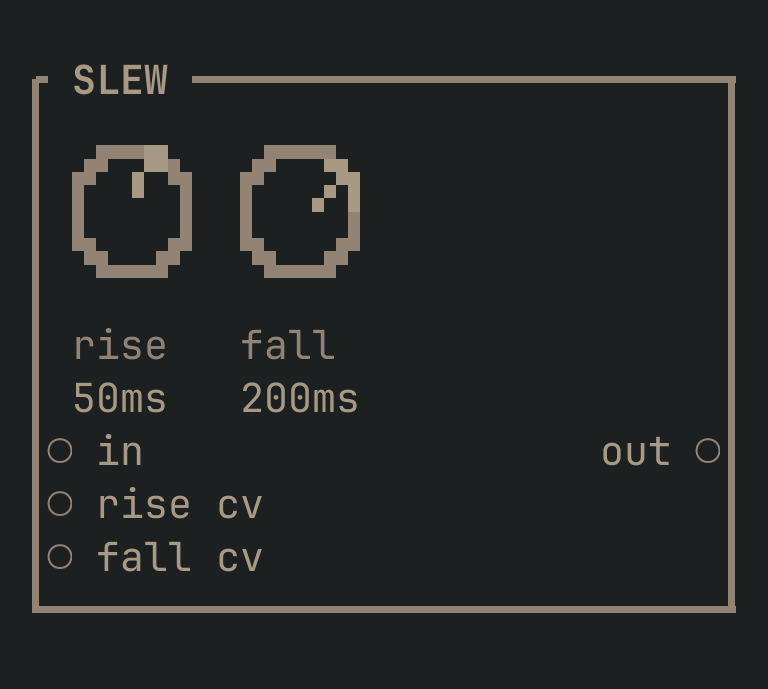
SLEW to get this card.inputs
Down the left edge of the card, top to bottom.
- incv
- The signal to smooth. A pitch CV here is portamento; a gate here is a cheap attack/release envelope.
- rise cvcv
- Modulates the rise time.
- fall cvcv
- Modulates the fall time.
outputs
Down the right edge, in the same order.
- outcv
- The smoothed signal.
knobs
Left to right across the face — the dials in the picture.
- rise0 … 5 s= 0.05 s
- Rise time. As portamento on a pitch this is the glide.
- fall0 … 5 s= 0.2 s
- Fall time. Making it slower than the rise is what turns a gate into an attack/release envelope.
more
The full reference — every parameter curve, the patching notes and the worked examples — lives in the manual: docs.vimsynth.com/modules/slew. In the app itself, :help SLEW opens the same page without leaving the rack.