vimsynth/modules/tide
modules/modulators/TIDE
TIDE
A function generator that is an envelope, an LFO and an oscillator at once, with the SHAPE on a knob. slope moves the peak from a sharp attack to a slow swell; curve bends each segment from exponential to logarithmic; warp folds it for complexity. In loop mode it free-runs as an LFO (or, turned up, an oscillator); in env mode a trig fires one cycle and it holds — a one-shot envelope with continuous slope and curve. eoc fires when a cycle ends, so one can clock the next. Patch a clock into clock and set pulses and the cycle is locked to the tempo — the rate is MEASURED from the pulse spacing, so a per-bar sweep stays a per-bar sweep without an automation writing rate.
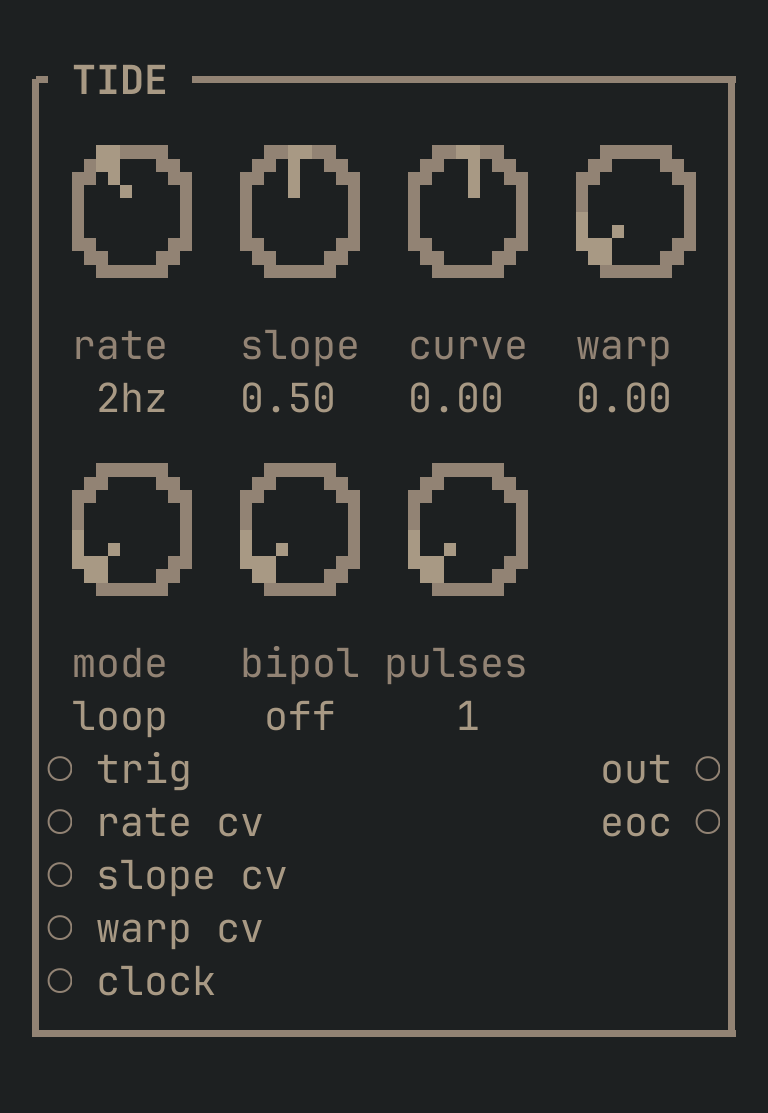
TIDE to get this card.inputs
Down the left edge of the card, top to bottom.
- trigtrigger
- In
envmode, fires a one-shot. Inloopmode, resets the phase — so a free-running shape can be kept in step with a clock. - rate cvpitch
- Moves the rate, in octaves. Track it from a SEQ and TIDE is a shaped oscillator that plays in tune.
- slope cvcv
- Added to
slope— sweep the peak from attack to swell under an envelope or LFO. - warp cvcv
- Added to
warp— open up the folding for a contour that gets more complex as it moves. - clocktrigger
- Locks the cycle to a clock. TIDE takes its RATE from the spacing of these pulses —
pulsessays how many of them one cycle spans — and re-lands on the boundary every time round, so it can neither drift nor need a tempo written into it. This is the difference fromtrig, which only says *start* and leaves a slightly-wrongrateto arrive early or late for the rest of the bar. Unpatched, TIDE free-runs from itsrateknob as always.
outputs
Down the right edge, in the same order.
- outcv
- The contour. Unipolar 0..1 unless
bipolis on. Into a VCA it is an amplitude envelope; onto a filter it is a sweep; into a v/oct it is a shaped LFO. - eoctrigger
- End of cycle — fires when a cycle completes. Chain it into another TIDE's trig, or use it as a clock derived from the shape.
knobs
Left to right across the face — the dials in the picture.
- rate0.02 … 2000 hz= 2 hz
- How fast. Slow is an LFO or an envelope; above ~20 Hz it is an oscillator with a shape you can sweep.
- slope0.02 … 0.98= 0.5
- Where the peak sits in the cycle. Low is a sharp attack and a long tail (percussion); high is a slow swell. The one knob an ADSR spends its attack and decay on.
- curve-1 … 1= 0
- How each segment bends: exponential (a natural-sounding decay), through linear, to logarithmic (a slow start that rushes).
- warp0 … 1= 0
- Folds the contour back on itself, adding wiggles — smooth at 0, complex and chaotic turned up.
- modeloop · env= loop
loopfree-runs it as an LFO or oscillator;envmakes atrigfire one cycle that then holds — a one-shot envelope.- bipoloff · on= off
- Unipolar (0..1) or bipolar (−1..1). Bipolar for anything that must go both ways, like pitch.
- pulses1 … 256= 1
- How many
clockpulses one cycle spans. Off a 1/16 clock, 16 is one contour per bar and 4 is one per beat. Inert until something is patched intoclock; while it is, this knob REPLACESrate.
more
The full reference — every parameter curve, the patching notes and the worked examples — lives in the manual: docs.vimsynth.com/modules/tide. In the app itself, :help TIDE opens the same page without leaving the rack.