vimsynth/modules/rand
modules/modulators/RAND
RAND
A generative random source you can steer between fresh-every-time and a repeating groove. Clock it, and loop is the whole idea: turned up it LOCKS the last few values into a pattern that repeats forever; turned down it is pure random; in the middle the groove drifts a note at a time. cv and cv2 are two different lines from the same loop; gate is a random rhythm whose density is bias. Patch cv through a QUANT for a melody that is random but in key.
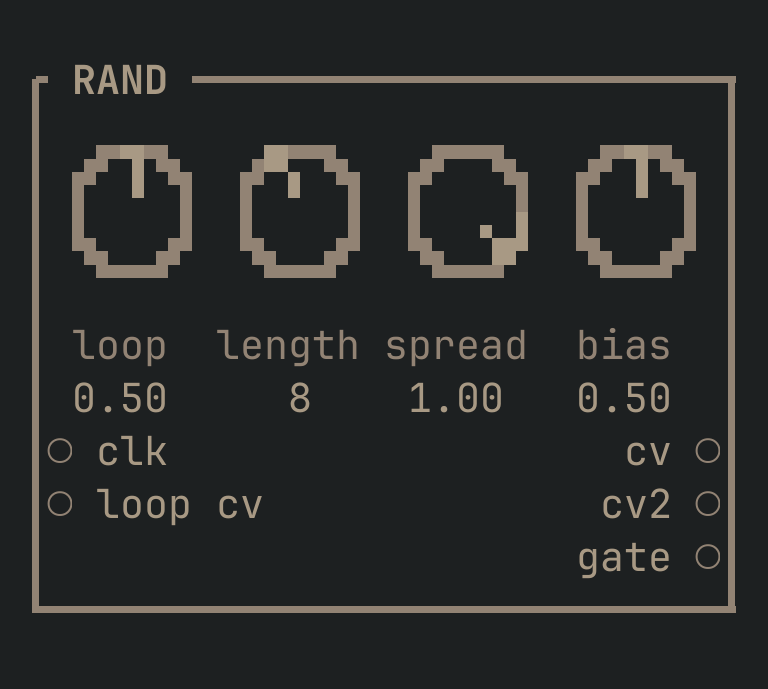
RAND to get this card.inputs
Down the left edge of the card, top to bottom.
- clktrigger
- Advances it. Every rising edge draws the next value — so its rhythm is whatever clocks it.
- loop cvcv
- Added to the
loopknob. Automating the lock — an envelope, or a hand on it at the drop — is the most musical thing you can do to this module.
outputs
Down the right edge, in the same order.
- cvcv
- A stepped random voltage, ±
spread. Through a QUANT it is a melody random but in key; onto a filter it is generative movement. - cv2cv
- A second voltage from the SAME loop, read differently — it locks when
cvlocks, but traces its own line. A two-part generative patch from one module. - gategate
- A random gate, high on the steps whose value clears
bias. Into an envelope, it is a rhythm that comes with the melody.
knobs
Left to right across the face — the dials in the picture.
- loop0 … 1= 0.5
- Déjà vu — the lock. 1 seals the last
lengthvalues into a loop that repeats for ever; 0 is fresh random; 0.5 lets the groove drift a note at a time. This is the whole module. - length2 … 16= 8
- How long the loop is, in clocks. Shorter loops are also CHUNKIER — the voltage has fewer steps — which is the honest behaviour of the mechanism.
- spread0 … 1= 1
- The output range.
cvandcv2swing ±this. - bias0 … 1= 0.5
- Gate density: the fraction of steps whose
gateis high. 0 is silent, 1 is a gate every step.
more
The full reference — every parameter curve, the patching notes and the worked examples — lives in the manual: docs.vimsynth.com/modules/rand. In the app itself, :help RAND opens the same page without leaving the rack.