vimsynth/modules/voc
modules/processors/VOC
VOC
A channel vocoder. mod (a voice, or anything with a moving spectrum) shapes car (a synth — a saw, a pad, noise) so the carrier TALKS: the robot-voice / talkbox effect. It splits both into 16 bands, follows the modulator's level per band, and gains the carrier's bands to match. formant shifts the spectrum up or down (voice size); attack/release set how crisp or smeared it is. For a classic vocoder patch a sampled voice (SMPL) into mod and a bright saw into car.
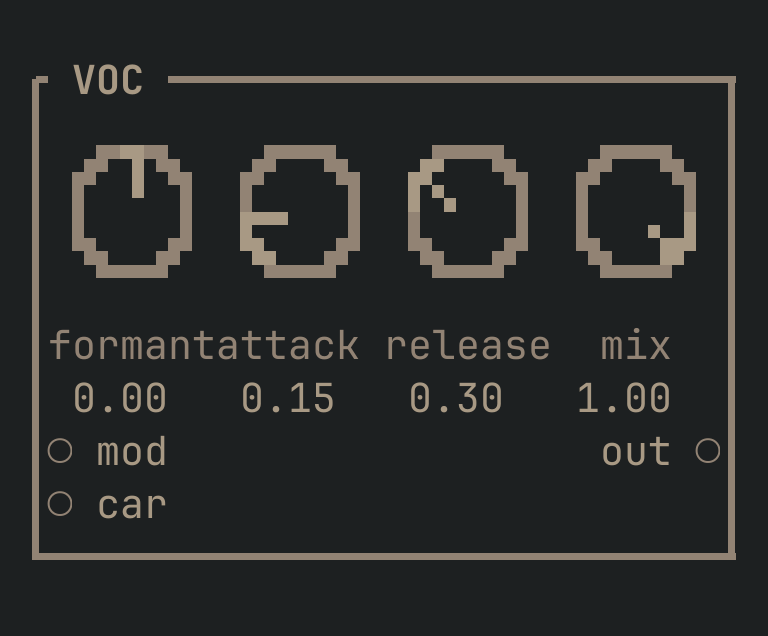
VOC to get this card.inputs
Down the left edge of the card, top to bottom.
- modaudio
- The modulator — a voice, or anything whose spectrum should shape the carrier.
- caraudio
- The carrier — a synth, a saw, noise. It comes out wearing the modulator's spectrum.
outputs
Down the right edge, in the same order.
- outaudio
- The carrier, shaped by the modulator's spectrum — the talking synth.
knobs
Left to right across the face — the dials in the picture.
- formant-1 … 1= 0
- Formant shift. 0 is voice-for-voice; positive lifts the spectrum (smaller, brighter), negative drops it (bigger, darker) — the size of the mouth, independent of pitch.
- attack0 … 1= 0.15
- Follower attack, fast at 0 to slow at 1. Fast keeps consonants crisp.
- release0 … 1= 0.3
- Follower release, fast at 0 to slow at 1. Slow smears the bands into a pad.
- mix0 … 1= 1
- Vocoded carrier against the raw carrier — how much of the effect.
more
The full reference — every parameter curve, the patching notes and the worked examples — lives in the manual: docs.vimsynth.com/modules/voc. In the app itself, :help VOC opens the same page without leaving the rack.