vimsynth/modules/wave
WAVE
A wavetable oscillator. Unlike the VCO its timbre is a continuous axis — pos sweeps through a row of waveforms and it takes a CABLE, so timbre can be modulated by an LFO or an envelope like anything else. table can also point at a sample bank slot, making any recording a wavetable.
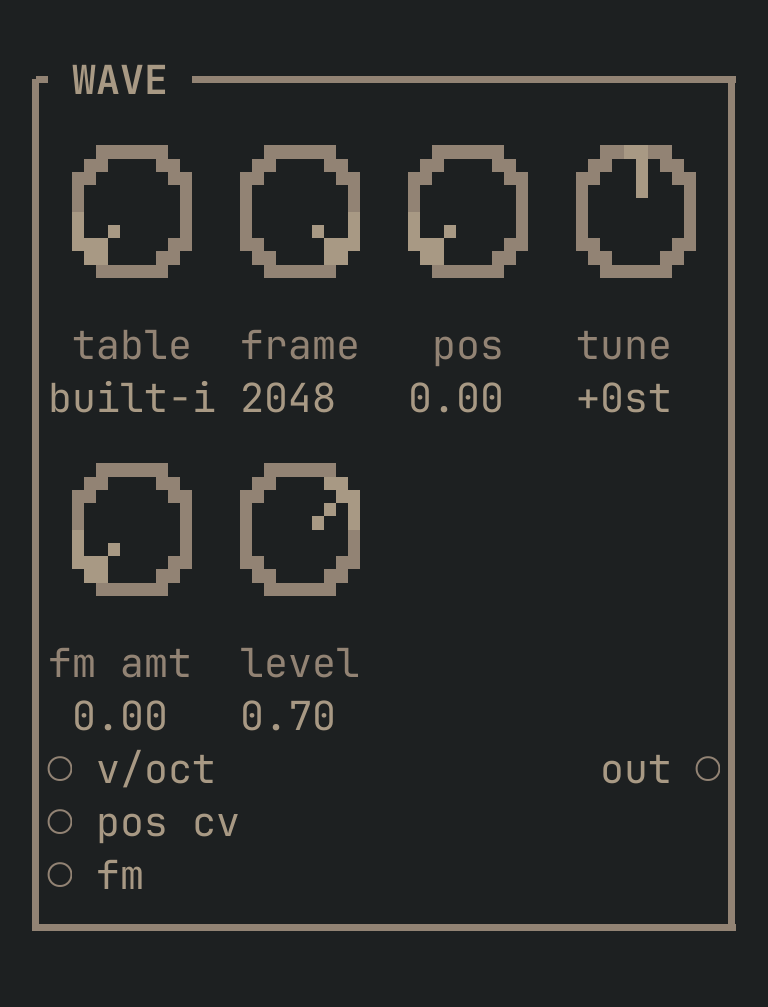
WAVE to get this card.inputs
Down the left edge of the card, top to bottom.
- v/octpitch
- Pitch. 1.0 = one octave up.
- pos cvcv
- Sweeps the position in the wavetable. THIS is what the VCO cannot do: modulate the timbre itself.
- fmcv
- Frequency modulation, scaled by
fm amt.
outputs
Down the right edge, in the same order.
- outaudio
- The sound.
knobs
Left to right across the face — the dials in the picture.
- tablebuilt-in · slot 0 · slot 1 · slot 2 · slot 3= built-in
- Which table.
built-inis a row of shapes from sine to something with teeth. A bank slot makes any recording into a wavetable. - frame256 · 512 · 1024 · 2048= 2048
- Samples per cycle when reading a bank slot.
- pos0 … 1= 0
- WHERE in the table. This is the module: a timbre you can sweep, and modulate with a cable.
- tune-24 … 24 st= 0 st
- Pitch offset in semitones.
- fm amt0 … 1= 0
- How far the
fminput moves the pitch. - level0 … 1= 0.7
- Output level.
more
The full reference — every parameter curve, the patching notes and the worked examples — lives in the manual: docs.vimsynth.com/modules/wave. In the app itself, :help WAVE opens the same page without leaving the rack.