vimsynth/modules/copy
modules/processors/COPY
COPY
A delay whose axis is GENERATION rather than time. It holds eight copies of the same material at once: generation 0 is what you are playing, generation 1 is that one loop later having been COPIED once — a little narrower, noisier, wowing, transposed by semis — and generation 2 is a copy of that. gen chooses which one you hear, continuously, so it sweeps and takes CV. Because a copy happens once per loop, generation k is BOTH k copies deep and k loops ago: sweeping gen is time travel where the past is worn. blend hears all eight at once (your past piling onto your present), hold freezes the lineage so it stops ageing, and oldest taps the last generation alone so the ruin can go somewhere the source does not. Reach for it when the words are degraded, decayed, half-remembered, tape, VHS, or when a delay should be an archive rather than an echo.
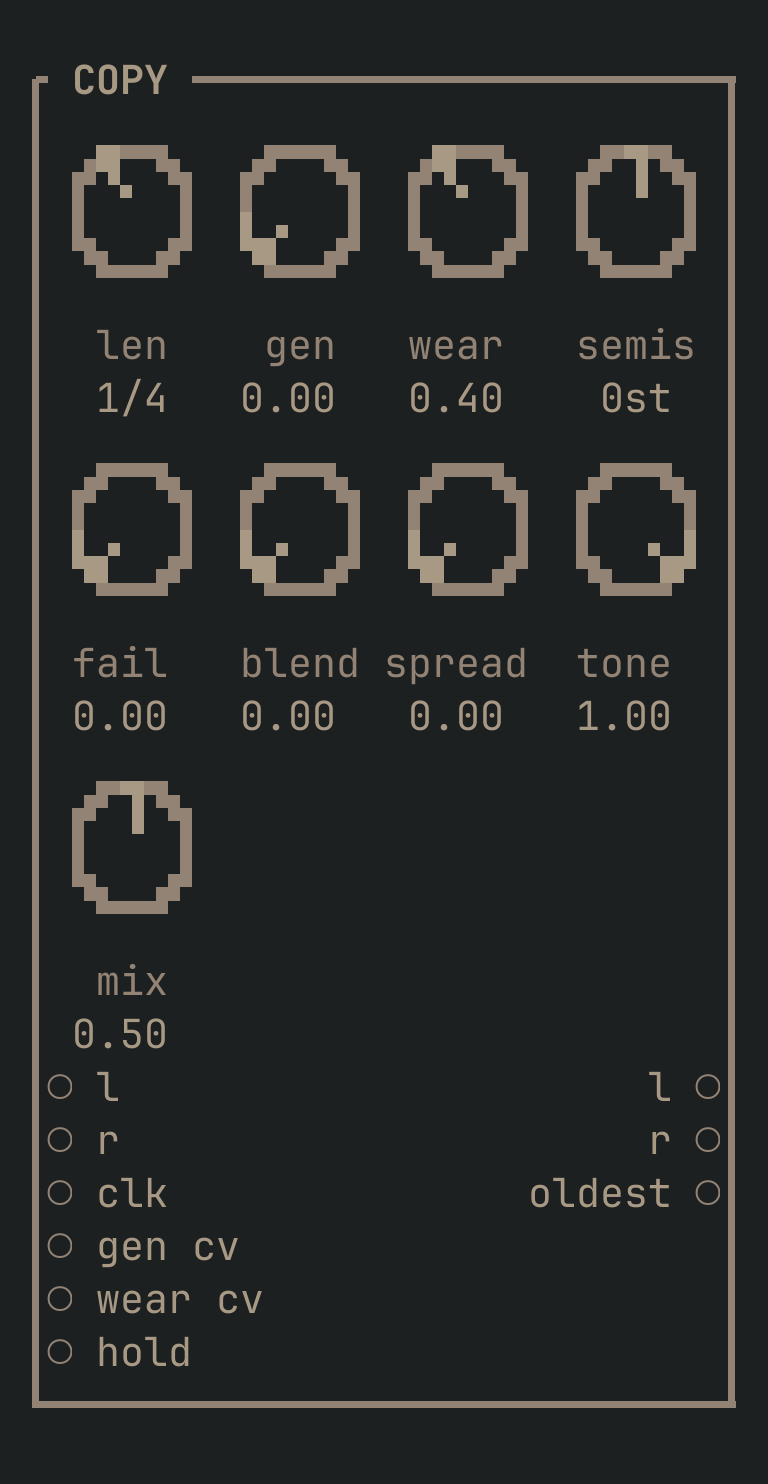
COPY to get this card.inputs
Down the left edge of the card, top to bottom.
- laudio
- The material to be copied, left. Generation 0 is this, untouched.
- raudio
- The right side. Normals from
l. - clktrigger
- The beat one generation is measured in. Since a copy happens once per generation, this is also how far apart in TIME the copies sit — patch the patch's own clock and the whole lineage stays in time. With nothing here a beat is assumed to be half a second (120 BPM) until two edges have been seen.
- gen cvcv
- Which copy you hear, summed with the knob — 1.0 moves one generation. THIS is the socket the module exists for: a sequencer here plays the lineage, stepping between now and six copies deep in rhythm, which no pedal has an input for.
- wear cvcv
- Moves what each copy costs, summed with the knob. An envelope here makes loud playing degrade faster than quiet playing.
- holdgate
- FREEZES the lineage: copying stops and every generation becomes a standing loop, so the eight of them hold still and you can play over a fixed archive without adding another remove to it.
outputs
Down the right edge, in the same order.
- laudio
- The generation
genpoints at, left — crossfaded with its neighbour, so the knob is continuous rather than an eight-position switch. - raudio
- The right side. With
spreadup the later generations sit further out, so the lineage opens into the field as it decays. - oldestaudio
- The LAST generation alone, unmixed — the most degraded copy, whatever
genandmixare doing. Send the ruin into a WARP and leave the source clean, which is the thing a pedal in a signal chain cannot do.
knobs
Left to right across the face — the dials in the picture.
- len1/16 · 1/8 · 1/4 · 1/2 · 1 · 2= 1/4
- How long ONE generation is, in beats of whatever is patched into
clk. It sets both the gap between copies and, because a copy happens once per loop, how far back in time generation 7 reaches: at1that is eight beats of history. - gen0 … 7= 0
- WHICH COPY you are listening to, 0 to 7, continuously. 0 is what you are playing now; 7 has been through the machine seven times. Sweeping it is time travel where the past is worn, because generation k is k copies deep AND k loops ago. Patch
gen cvand a sequencer plays the lineage. - wear0 … 1= 0.4
- What each copy COSTS: bandwidth, a noise floor, and how far the wow wanders. Gentle per stage on purpose — eight cascaded filters would be mud by generation four — so most of the character is the noise and the instability rather than the loss of top.
- semis-12 … 12 st= 0 st
- Semitones added by EVERY copy. 0 is off (and genuinely bypassed). +7 makes generation 3 a stack of fifths and a
gensweep a glissando up them; −12 sinks the lineage an octave a copy. Stepped, so it is never between intervals. - fail0 … 1= 0
- How often a copy DROPS OUT — the snags and wrinkles of a worn tape. Up from zero the older generations start losing pieces of themselves, and what is lost is then copied onward.
- blend0 … 1= 0
- 0 hears the one generation
genpoints at; 1 hears ALL EIGHT at once — your past piling onto your present, which is the other thing this shape can do. - spread0 … 1= 0
- How far apart the generations sit in the stereo field. Later ones sit wider, so the lineage opens outward as it decays. Only audible with
blendup, where more than one is being heard. - tone0 … 1= 1
- A lowpass over the result, 1.0 wide open. Distinct from
wear, which acts once per copy: this is the tone control on what you hear, where that one is the tone of the copying. - mix0 … 1= 0.5
- Dry/wet.
more
The full reference — every parameter curve, the patching notes and the worked examples — lives in the manual: docs.vimsynth.com/modules/copy. In the app itself, :help COPY opens the same page without leaving the rack.