vimsynth/modules/eq
EQ
A four-band equaliser for a stereo BUS — a low shelf, two sweepable bells with their own width, and a high shelf. This is the TOOL, where VCF is the instrument: it does not sweep or resonate, it changes the balance of a mix rather than the character of a voice. Reach for it to take 3 dB out of a boxy low-mid, notch one ringing frequency, or lift some air on top. Flat at its defaults, so dropping one in changes nothing until you turn a knob. r normals from l, so a mono source needs one cable.
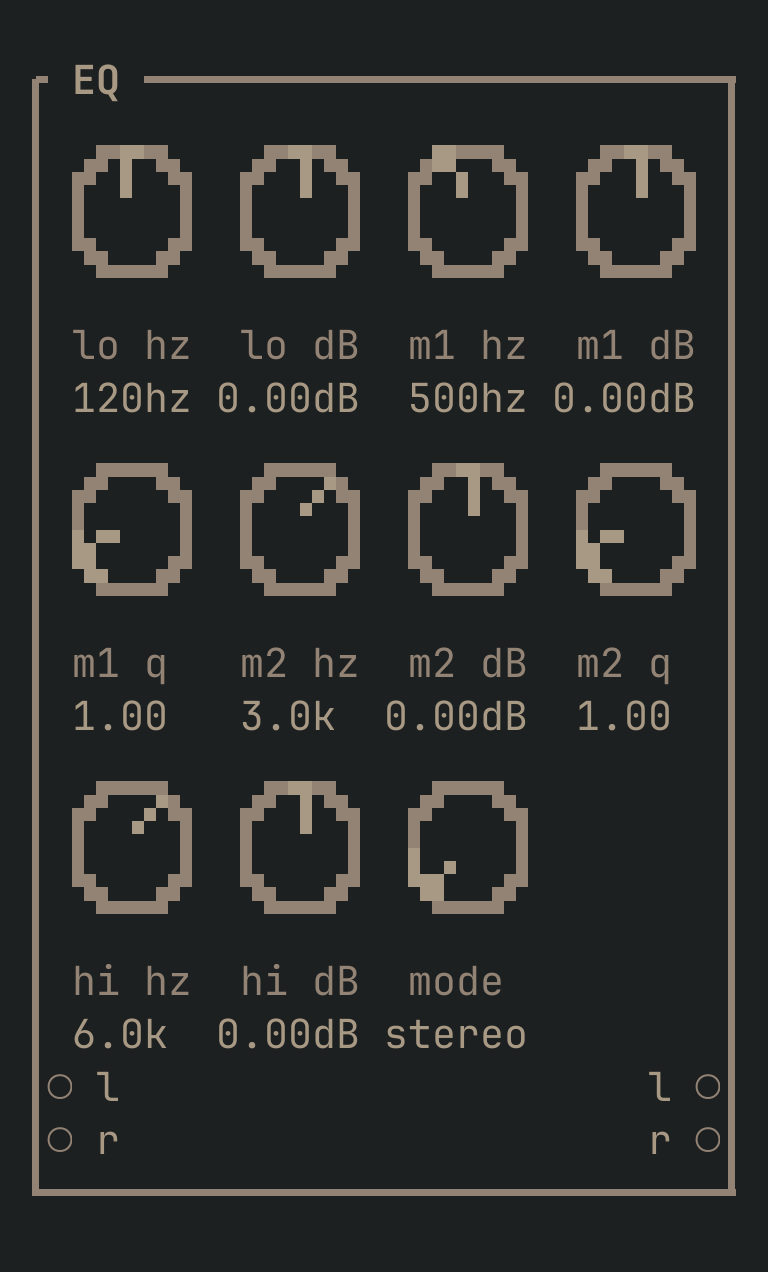
EQ to get this card.inputs
Down the left edge of the card, top to bottom.
- laudio
- Left in — or the whole signal, if it is mono.
- raudio
- Right in. NORMALS from
l, so a mono source patched intolalone is EQ'd and comes out of both sides.
outputs
Down the right edge, in the same order.
- laudio
- Left, equalised.
- raudio
- Right, equalised.
knobs
Left to right across the face — the dials in the picture.
- lo hz20 … 1000 hz= 120 hz
- Where the low shelf turns over — the whole bottom below it moves together.
- lo dB-18 … 18 dB= 0 dB
- Lift or cut the bottom. A dB or two is a mix decision; six is an effect.
- m1 hz60 … 8000 hz= 500 hz
- The first bell's centre.
- m1 dB-18 … 18 dB= 0 dB
- Lift or cut it. CUTTING is the underrated half: taking 3 dB out of a boxy 300 Hz does more for a mix than boosting anything.
- m1 q0.3 … 8= 1
- How WIDE that bell is. Low is a gentle tilt across octaves; high is a surgical notch for one ringing frequency.
- m2 hz200 … 16000 hz= 3000 hz
- The second bell's centre — usually the presence range, where an instrument either speaks or does not.
- m2 dB-18 … 18 dB= 0 dB
- Lift or cut it.
- m2 q0.3 … 8= 1
- Its width, as the first bell's.
- hi hz1000 … 18000 hz= 6000 hz
- Where the high shelf turns over.
- hi dB-18 … 18 dB= 0 dB
- Lift or cut the top. This is 'air' — and the first thing to try when a patch sounds dull is a little here rather than more resonance somewhere else.
- modestereo · mid · side= stereo
- WHAT it equalises.
stereois both channels.midtouches only what both sides share — where the bass, the kick and the vocal live — andsideonly what differs, which is the reverb and the width. A CHOICE, so it cannot be modulated. Two EQs, one on each, is how you shape the middle and the edges differently.
more
The full reference — every parameter curve, the patching notes and the worked examples — lives in the manual: docs.vimsynth.com/modules/eq. In the app itself, :help EQ opens the same page without leaving the rack.