vimsynth/modules/warp
modules/processors/WARP
WARP
A reverb whose TANK IS SCALED BY ONE RATE, in octaves, with a 1 v/oct input under it. Every delay inside moves together, so the whole room transposes: sweeping it BENDS whatever is still ringing, the way a tape transport does, and far enough up (+3, +4) the lines get short enough that the tank stops echoing and starts RINGING at a pitch — a resonator a sequencer can play, on the rack's own scale with snap on. Three textures (countable echoes, plate, slow wash), a shimmer fed back through the regeneration at any interval, a pre-delay with its own echo tapped out separately, and a freeze gate that holds the tank indefinitely. Reach for this over REVERB when the words are warped, alien, seasick, or when the reverb should be an instrument rather than a space.
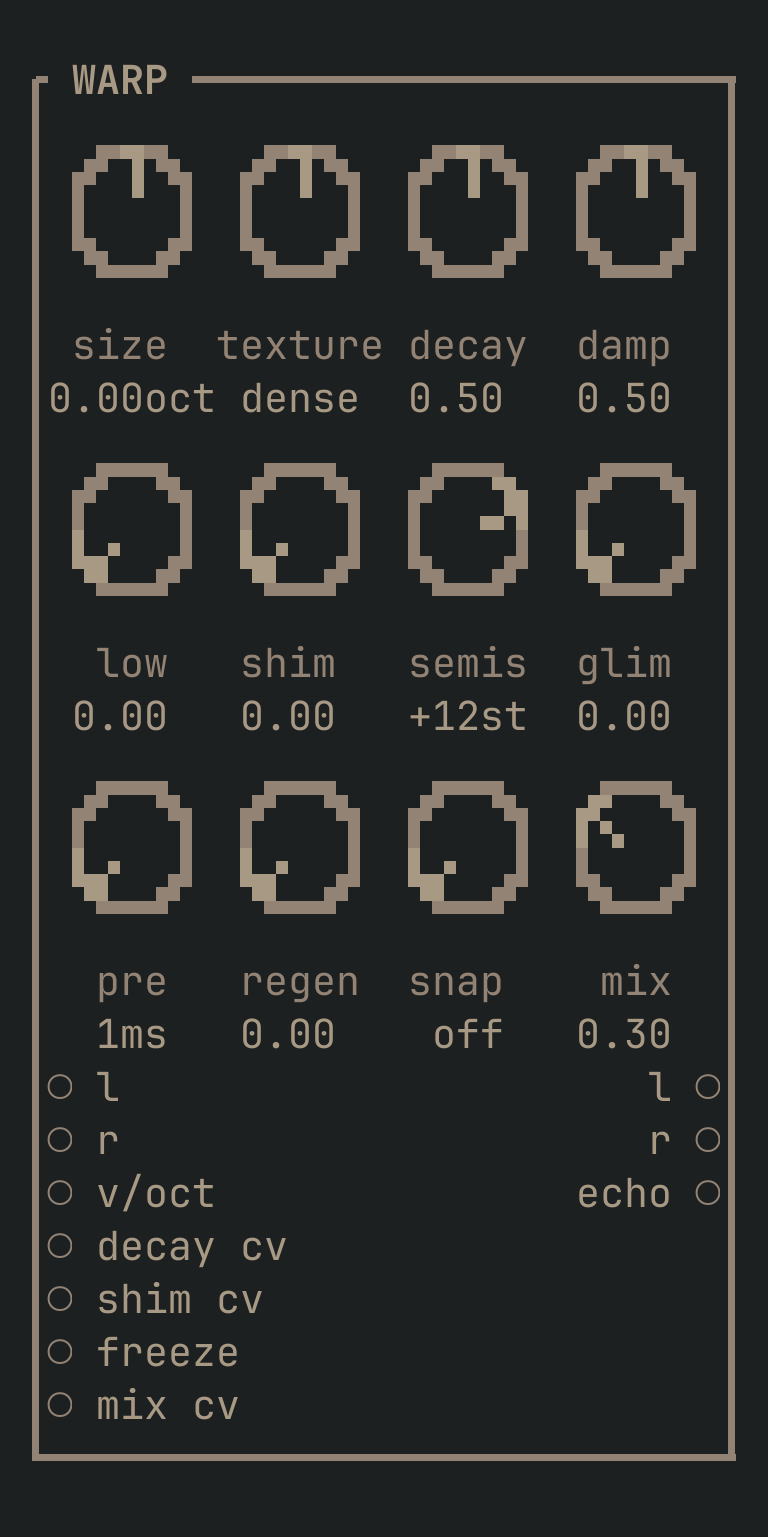
WARP to get this card.inputs
Down the left edge of the card, top to bottom.
- laudio
- The signal to send into the tank, left. Each side runs its own bank of lines, so a stereo source keeps its image through the room.
- raudio
- The right side. Normals from
l, so ONE cable in is an ordinary mono send. - v/octpitch
- The tank's RATE, 1.0 = one octave, summed with the
sizeknob. This is the module: patch a sequencer here and the ROOM plays the line — every delay in the tank scales together, so the whole space transposes. Withsnapon it lands on the degrees of the rack's scale. - decay cvcv
- Moves how long the tail rings, summed with the knob. An envelope here opens the room on the loud parts.
- shim cvcv
- Moves how much of the tail is fed back at
semis, summed with the knob. - freezegate
- HOLDS the tank while it is high: the loop goes to unity and nothing new is let in, so the wash sustains until you drop the gate. The dry path and the
echotap carry on regardless, so you can play OVER a frozen chord. Ramped, not switched, so it does not click. - mix cvcv
- Moves the dry/wet crossfade, summed with the knob.
outputs
Down the right edge, in the same order.
- laudio
- Left. The tank is born stereo — take both, or you throw away half the room.
- raudio
- Right.
- echoaudio
- The PRE-DELAY on its own, before the tank and unmixed — the repeats
preandregenmake, whatevermixis doing. This is the thing a rack can do with a pre-delay that a pedal cannot: send the room one way and the echo somewhere else.
knobs
Left to right across the face — the dials in the picture.
- size-2 … 2 oct= 0 oct
- The tank's RATE, in OCTAVES, summed with the
v/octinput. 0 is an ordinary room; each octave up halves it, and by +3 or +4 the lines are short enough to RING at a pitch you can play. Down two is bigger and slower, which is as far as a room means anything. Sweeping it bends everything already sounding, the way a tape transport does — it is a speed control, not a size knob. - texturesparse · dense · diffuse= dense
- What sits between the lines.
sparseis four lines and no diffusion, so the reflections stay countable — a room on sustained input, distinct echoes on a staccato one.denseis the plate: immediate and smooth, the one to pick when the word is just 'reverb'.diffusebuilds slowly into a wash, which is what reads as 'ambient', 'atmospheric' or 'reverse'. - decay0 … 1= 0.5
- How long the tail rings. 0.5 is a room, 0.9+ is a cavern that takes its time. Use the
freezegate, not this, for a tail that never ends. - damp0 … 1= 0.5
- How fast the top of the tail dies INSIDE the loop, the way air eats the high end over distance. High is soft and distant; low is bright and glassy.
- low0 … 1= 0
- A highpass INSIDE the loop — the hardware's LOW DAMP. Up from zero it stops the bottom end piling up trip after trip, which is the difference between a long tail and a rumble under the bass.
- shim0 … 1= 0
- SHIMMER — how much of the tail is fed back through a pitch shifter at
semis, so the room grows a voice above (or below) itself that climbs with every pass. This is 'ethereal', 'angelic', 'celestial'. Start around 0.2–0.4. - semis-24 … 24 st= 12 st
- The shimmer's INTERVAL, in semitones. +12 is the octave everyone means by shimmer; −12 grows a floor underneath instead; +7 and +19 are where it stops being an effect and starts being a choir. Equal temperament, so it does not move when the rack retunes.
- glim0 … 1= 0
- GLIMMER — lifts the input's own top harmonics before the tank hears them, in proportion to how loud the source is, so a played note sparkles and a decaying tail does not.
- pre0.001 … 1.5 s= 0.001 s
- PRE-DELAY: the gap before the room starts, up to 1.5 s. A short one (20–80 ms) keeps a vocal or a lead clear of its own reverb; a long one is an echo that the room then answers.
- regen0 … 0.95= 0
- Feedback on the pre-delay, so it repeats. This turns the front of the module into a delay in its own right — take it from
echo, and the tank hears the repeats rather than only the input. - snapoff · scale= off
- Snap the tank's rate to the degrees of the RACK's scale (
:tune), so the room lands on notes of the current key rather than on a chromatic ladder. With a sequencer onv/octthis is what makes the reverb playable. - mix0 … 1= 0.3
- Dry/wet CROSSFADE. 0.2–0.4 is a room; above 0.6 the tank is the sound, which is what you want when it is being played rather than being a space.
more
The full reference — every parameter curve, the patching notes and the worked examples — lives in the manual: docs.vimsynth.com/modules/warp. In the app itself, :help WARP opens the same page without leaving the rack.